
 View what's in this topic
Before you begin
About PersonalEffect
XMPie PersonalEffect® Cross Media is an award-winning Customer Communication Management (CCM) solution specializing in Variable Data Publishing (VDP).
PersonalEffect is a modular solution including a suite of products which work together to produce multichannel personalized communications. These products are highly specialized to address the needs of the professionals they are serving:
-
Campaign management tool
Circle is your campaign management, visualization and automation tool offering an interactive digital storyboard for planning, implementing, and automating multichannel campaigns. Circle makes it easier to explain, sell and manage your campaigns. Circle is a tool for sales representatives and marketing agencies that plan campaigns as well as for production managers who run operations.
-
Creative tools
XMPie tools, which are fully integrated into the industry-standard Adobe suite, allow you to add personalization to your print and video designs.
-
uCreate Print plug-in for Adobe InDesign for creating personalized print documents. This tool is mainly used by designers and studio managers. uCreate Print may come with add-on modules for personalizing images (uImage® ) and charts (uChart®). For more information, see uCreate Print documentation and uImage documentation.
-
XMPie Video Service (XVS) is a plug-in for Adobe After Effects for creating personalized videos.
Both email and web use the XMPie Open XM technology to add personalization.
-
-
Logic tool
uPlan is a tool for specifying the Logic component of a print document, email or website (essentially the rules, the data schema and the content objects exported to the design). uPlan is used by programmers or database administrators. For more information on uPlan, see the uPlan documentation.
-
Production engine
uProduce is server-based software for binding the logic, data, and design to create personalized print documents, emails or websites, and for processing them, as needed. uProduce serves as a back-end production engine whereas the production is managed via Circle user interface. For more information on uProduce, see uProduce setup and monitoring.
-
Analytics tool
-
Circle Analytics allows for tracking and analyzing campaign performance. For more information, see Circle analytics.
Different members of the campaign development team can work on various aspects of the same campaign independently. After creating an initial plan that defines the content objects, the database professionals, programmers and sometimes even business managers can continue using uPlan, to further refine the campaign's data and logic. At the same time, designers and studio professionals can use uCreate Print to work on the print design and web developers can use Open XM or any web development tool to create web design.
The PersonalEffect solution provides cost-effective variable data publishing implementations, without limiting the design scope or trivializing the data or rules model. Moreover, PersonalEffect provides a unified, consistent and streamlined approach to handling multiple media channels, integrating with other systems for automation, workflow, e-commerce, etc.
XMPie Personalization
The integration of design, logic, and data to serve multiple media channels is at the heart of XMPie’s personalization technology and multichannel customer communications management solution. Our software is engineered to make it easy to integrate each channel, with no compromise on creativity, into an effective cross media customer experience. The latest web technologies are supported with Open XM technology so that your digital content can holistically coexist with state-of-the art variable print designs.
Binding Design, Data and Logic
The PersonalEffect personalization is based on the concept of binding Design, Data and Logic to produce multichannel campaigns.
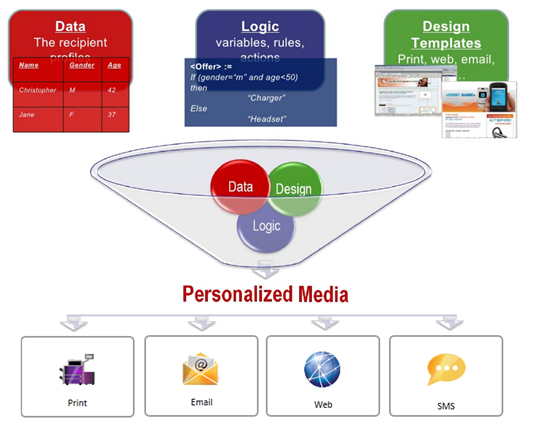
Whether a campaign consists of print, email or web, or a combination of any of these – with XMPie, all designs share the same Logic and Data, thus, enabling a truly holistic brand experience.
-
Logic component: represented by a plan file containing the rules and logic of the campaign
-
Data component: represented by a data source (for example, an Excel sheet or a database);
-
Design component: marketing print/email/web design. These designs include content objects at all places where personalization is required.
During production, content object values are resolved. The content object binds the design to the logic for the specified recipient’s data and the resolved value is the personalized output for that specific recipient.
PersonalEffect Architecture
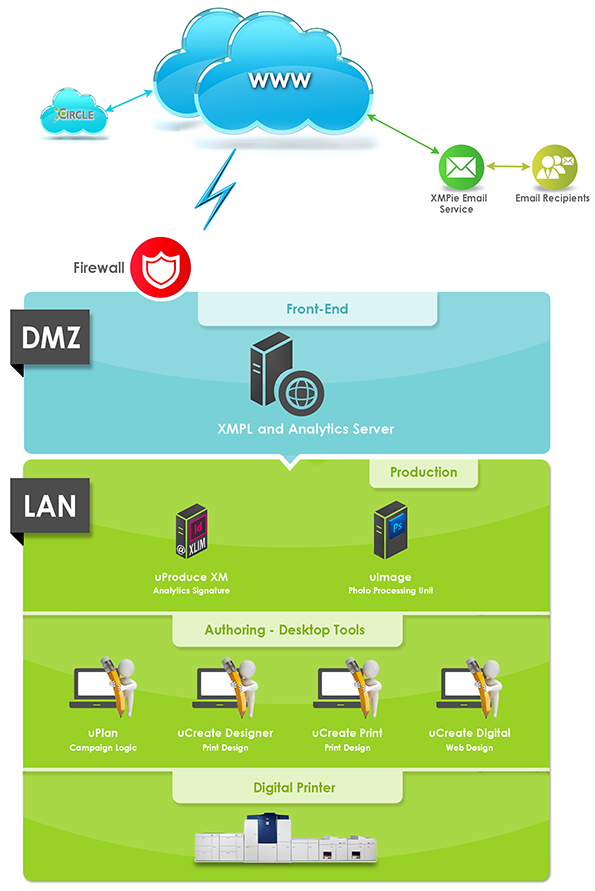
Core Technologies
ADOR technology
PersonalEffect is built on top of XMPie's unique Automatic Dynamic Object Replacement (ADOR®) Technology which drives the cross media personalization capabilities of the XMPie solutions.
The ADOR technology uses content objects to introduce personalization to the existing Design. A content object is an object of the plan that is visible to a design. Content objects can be of various design-centric types, for example, text or graphic. The designer uses simple point-and-click operations to tag a design object (say, a text frame or graphic frame) with the desired content object. Such a tagged design object becomes a dynamic object: a design object that derives its content and/or appearance from the content object’s value. Content object values are calculated by the plan’s rules, using the given data source(s). These calculations are performed iteratively, once for each recipient, resulting in a set of recipient-specific values for each content object. In a way, one can think of content objects as the intermediaries between the logic (that is, plan) and data (that is, data source) and the design (that is, XMPie tagged document).
The ADOR technology also provides the campaign object (represented in 2G as project), which essentially defines a collection of dynamic documents. The unique property of a campaign is that all of its tagged designs can be matched to the content objects defined by its plan, and that the campaign's data source matches the data schema defined by its plan.
Open XM Technology
In addition, the Open XM™ cross-media technology is the core mechanism for achieving personalization for digital media (email and web). The Open XM is a stack including XMPL HTML, XMPL JavaScript and XMPL Rest API.
The XMPL HTML extends the HTML tagging language by adding new directives (tags and attributes) that provide the needed personalization functionality. This is a very rich language and is covered in the XMPL SDK (https://github.com/XMPieLab/XMPL-SDK/wiki). Using XMPL HTML one can easily convert a standard HTML website to a personalized page by adding a few personalization tags and a code snippet.
The XMPL technology uses HTML code snippets to modify the standard HTML behavior. This snippet method is a common practice in modern web development, for example, it is used to include Google Analtyics, Facebook Like, and other components in a webpage.
The XMPL JavaScript provides a personalization JavaScript library for client side developers. The XMPL REST API provides personalization API for any client on the Internet, including mobile devices, servers, and web applications.