
 View what's in this topic
Job Management
In uProduce, a job is a production operation. uProduce allows you to create different types of jobs: print, proof, port, email, etc.
In the Job Center you can view the status of all jobs that belong to a specific customer, manage these jobs (for example, abort or delete a job) and access the job output (a print output file, an email, etc.).
To access the Job Center, click the Job Center button of the navigation bar.
The Job Center page provides information on the print, email and HTML jobs sent to production, as well as ICP Port jobs, in all accounts the current user has permission to see. The page is divided into the following panes:
-
Job list
-
Job filters
-
Job details
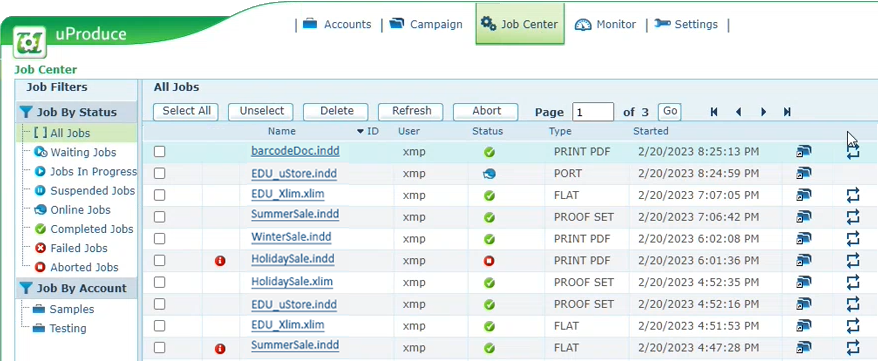
Job list
The following image provides a closer look at the Jobs List pane of the Job Center.
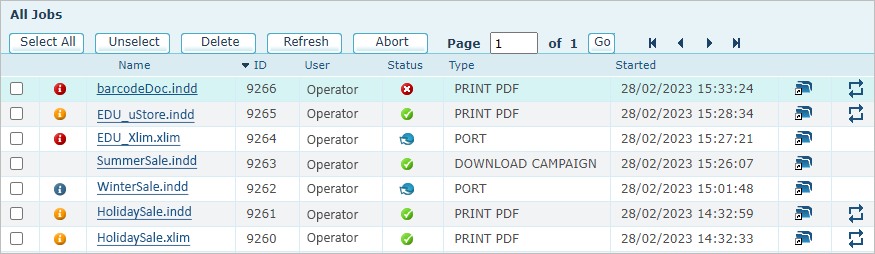
The jobs list shows the main job details and allows you to perform various management operations using the buttons at the top of the pane.
The list provides the following options and details on each job:
-
ID: The unique identifier of this job in the uProduce system.
Note: When a job is split to batches that are processed in parallel, all batches share the same job ID and appear as a single job in the Job Center.
-
Status: The job’s production status - Waiting, In Progress etc.
For a description of the possible statuses, see Job By Status. -
Information icon: if there is any special information concerning this job, one of the following icons is displayed:
-
 Indicates
a message, providing useful information that
does not call for an action (for example, notifies that a PDF On Demand
has been generated for a specific recipient, or provides a summary of
the job production notes).
Indicates
a message, providing useful information that
does not call for an action (for example, notifies that a PDF On Demand
has been generated for a specific recipient, or provides a summary of
the job production notes). -
 Indicates
a warning concerning a job that was completed
according to the processing policies,
but has issues the user should address (for example, missing assets; or
an email batch that failed for a specific recipient).
Indicates
a warning concerning a job that was completed
according to the processing policies,
but has issues the user should address (for example, missing assets; or
an email batch that failed for a specific recipient). -
 indicates
an error, describing a problem that caused the
job to fail (for example, an error in the plan file).
indicates
an error, describing a problem that caused the
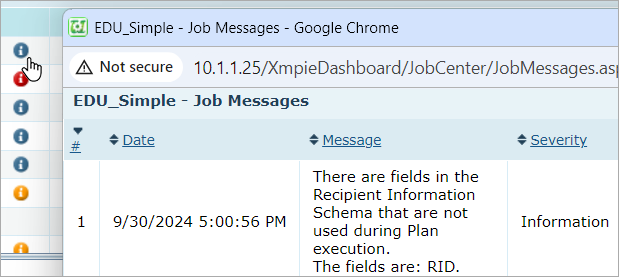
job to fail (for example, an error in the plan file).Clicking the icon opens a pop-up window, listing all messages generated for this job, with the relevant message selected.
The following image shows an example message icon and the message it displays for an aborted job.
-
-
Name: the name of the document, port or email activity used to produce this job.
-
Type: The type of this production job, which may be one of the following:
-
PRINT <Output Format>: A job that generates an output file for printing (known as the print output file) in the specified output format — for example, PRINT PDF, PRINT PDF/VT-3 or PRINT PNG. For the full list of print output formats, see Production.
-
PROOF <Output Format>: A job that generates an output file for proofing in the specified output format: PDF, Interactive PDF, JPG, PNG, EPUB (Fixed Layout) or EPUB (Reflowable).
-
DOWNLOAD DOCUMENT: A job that generates a document package (DPKG).
-
DOWNLOAD CAMPAIGN: A job that generates a campaign package (CPKG).
-
PROOF SET: A job that generates a proof set.
-
BATCH: A job that produces HTML output for a batch of recipients.
-
PORT: Represents an Interactive Content Port (ICP), used to provide live recipient data to applications and websites. An ICP allows you to both receive and update recipient information. It is used to provide data for personalized websites and to uCreate Connectivity.
-
ON DEMAND PRINT: Represents an InDesign or XLIM document that has been placed online, and can be used by uProduce to generate HTMLs On Demand.
-
ON DEMAND <Output Format>: Represents a document that has been placed online, and can be used by uProduce to generate output On Demand. The output format is appended to the type, so an HTML or TXT document placed online appears as ON DEMAND HTML.
-
EMAIL SEND: An email batch that has been sent to the campaign recipient list (or to some recipients on this list).
-
EMAIL PREFLIGHT:An email batch that has been validated: uProduce has gone through all production steps, except for actually sending the email to the campaign recipient list (or to some recipients on this list).
-
EMAIL TEST: An email batch sent to an email address that serves testing purposes.
-
TRIGGERED EMAIL: An email triggered by an event on a website (Page Load, Self-Registration or Referral). This job is automatically created once a triggered email is sent from a website. If the email activity on which the triggered email is based has been modified or deleted, the job will be marked as completed and the next time a triggered email will be sent, a new job will be created.
-
FLAT: A job that generates a CSVX file, containing the ADOR object values for each record on the recipient List.
-
EXTERNAL: A job containing tracking information on another job that was not performed by uProduce (for example, a dynamic print job produced by uCreate Print).
-
TASK: A background task the server ran on its own, rather than a production job — for example, generating a report, or hosting or exporting a data source. A task has no campaign, so the Link to Campaign icon is not shown for it.
-
-
Started: The date and time on which this job’s production has started.
-
User:The name of the uProduce user who submitted this job.
-
 (Resubmit job): Runs the job again. Clicking the icon takes you to the
process page, populated with the job's properties, where you can make
changes before resubmitting the job.
(Resubmit job): Runs the job again. Clicking the icon takes you to the
process page, populated with the job's properties, where you can make
changes before resubmitting the job.Note that in case of a sub-job created from a split job submission, the resubmit will use the range of the sub-job and not of the original job range.
This icon appears only for jobs that can be resubmitted: PRINT, PROOF and FLAT jobs. It is not shown for other job types, such as PORT or DOWNLOAD CAMPAIGN.
-
 (Link to Campaign): Click the
icon to go to the campaign for which this job was produced (by default,
this link shows the documents page).
(Link to Campaign): Click the
icon to go to the campaign for which this job was produced (by default,
this link shows the documents page). This icon is not shown for a job that has no campaign, such as a report task, or for a job that belongs to a Circle campaign.
Notes:
-
To download the job output, click its status icon
 .
. -
To stop the production of a selected job, click Abort.
-
To remove jobs, select them using the checkboxes at the left of the list and click Delete. This deletes the jobs together with their output files, and cannot be undone.
Job filters
The following image provides a closer look at the Job Filters pane of the Job Center.
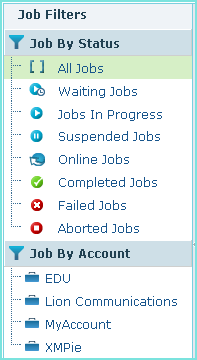
You can filter the Jobs List by status or account.
Job by status
Select All Jobs to list every job you have permission to see. This is the default. To narrow the list, select one of the following job statuses instead:
-
Waiting
 : a job that is currently
in the waiting queue, and will be processed based on its priority.
: a job that is currently
in the waiting queue, and will be processed based on its priority. -
In Progress
 : a job whose
production is currently in progress.
: a job whose
production is currently in progress. -
Suspended
 : a job whose status
is online and whose type is either PORT
or ON DEMAND PRINT, which a user has
put temporarily on hold. Jobs are suspended in order to depute the campaign
or to prevent access to a website.
: a job whose status
is online and whose type is either PORT
or ON DEMAND PRINT, which a user has
put temporarily on hold. Jobs are suspended in order to depute the campaign
or to prevent access to a website. -
Online
 : the status of one
of the following job types, as long as they are available: PORT,
and ON DEMAND PRINT and
ON DEMAND HTML.
: the status of one
of the following job types, as long as they are available: PORT,
and ON DEMAND PRINT and
ON DEMAND HTML. -
Completed
: a job that was produced
successfully. -
Failed
 : a job whose production
has failed.
: a job whose production
has failed. -
Aborted
 : a job whose production
has been canceled by the user.
: a job whose production
has been canceled by the user.
Note: If a job is associated with other jobs, the job’s status icon includes a plus sign. For example, if you produce an EMAIL SEND job, whose body includes a link to a PDF, the each job’s status icon will have a plus sign:
-
The status of a completed EMAIL SEND job will appear as follows:

-
The status of an ON DEMAND PRINT job will appear as follows:

Job by account
You can filter the display by showing only jobs that belong to a specific uProduce account. To apply the filter, click the name of the relevant account.
Job details
The Job Details pane at the bottom of the Job Center presents the full job ticket — every setting the job actually ran with. To open it, click a job’s name in the jobs list. By default, the first job on each page is selected. The heading of the pane shows the job name and its ID.
The details are organized into sections, always in the order listed below. A section appears only when it applies to the job, so most jobs show a handful of the sections rather than all of them: a campaign package job may show only General, Timing, Production Metrics, Output Files and Export, while a print job also shows the plan, document, recipients, assets and output settings. Individual values behave the same way — they are listed only when they have something to report.
Two things are worth knowing when you read the pane:
-
The account, campaign, document, plan, data source, email template, hot folder, destination and post composition operation values are links. Each shows its name followed by its ID, and takes you to that item. The creator is shown the same way but is not a link.
-
Sizes and dimensions are shown in the measurement unit set in User Preferences, so two users may see the same job described in different units.
Note: The Type value in the Job Details pane is not always worded the same as the Type column in the jobs list. A campaign package job, for example, is listed as DOWNLOAD CAMPAIGN in the list and as Campaign Package in the details.
Sections
|
Section |
What it shows |
|---|---|
|
General |
The job’s status and type, the account, campaign, campaign type, creator and document it ran for, the highest message severity it produced, its priority and turbo mode, whether a completion email was triggered, and its place in a job hierarchy (Solo Job, Parent Job or Child Job). |
|
Timing |
When the job was submitted, started and ended, how long it took, and which machine processed it. |
|
Production Metrics |
Estimated and processed record counts, generated pages, click charge and output size. Records per minute is added for completed jobs of more than 100 records. |
|
Plan |
The plan the job used, whether trivial mode was on, and any ADOR filters applied. |
|
Document |
The document, its type, its web resources path, and whether campaign fonts or custom fonts were used. |
|
Recipients |
Which recipients were produced: the population or port, the record range, how the job was split into batches, any ID filter, and each recipient data source with its filter, sorting and range. |
|
Schema Data Sources |
Any further data sources the plan’s schema draws on. |
|
Assets |
How assets were resolved: campaign asset sources, media type, URL prefix, and the asset sources used. |
|
Email Message |
For an email job, the message envelope and body: subject, sender, reply-to, recipients, and the character sets used. |
|
Delivery Provider |
The delivery provider that sent an email job. |
|
Output Settings |
The output format and the settings that go with it — PDF compatibility and standards, separate file per record, flattening, resolution and grayscale for image formats, number of copies, and how the output file was named. |
|
PDF Security |
Whether an open password or a permissions password was applied, and which actions were disallowed. |
|
PDF Accessibility |
The document language passed to screen readers. |
|
PDF/VT Metadata |
The PDF/VT Recipient Attributes configured for the job. Each attribute is listed as Category / Field with its fixed value or its source ADOR. |
|
Bleed |
Whether the document’s own bleed definition was used, or the bleed values that were applied instead. |
|
Printer Marks |
Which printer marks were added, and their offset and weight. |
|
Liquid Layout |
The page width and height the liquid layout was applied at. |
|
Filler Pages |
The filler page action, and where the pages were inserted. |
|
Production Policies |
What the job was told to do about missing fonts, missing assets, missing styles, text overflow and the file size limit. |
|
Friendly URLs |
The domain, folder and landing page used for the personalized URLs. |
|
Tracking |
The touchpoint the job was associated with, and what was tracked: events, ADOR values and link clicks. |
|
Imposition |
The imposition applied through the deprecated Imposition section of the Process page. |
|
Destinations |
The copy, FTP and print destinations set in the deprecated Legacy Operations section. |
|
Post-Composition Operations |
Every post composition operation the job ran, in the order it ran them, with the operation type in brackets. An operation defined in Settings links to its settings page; one defined in the job ticket itself lists its properties instead. |
|
Compression |
The name of the compressed output file, when output compression was used. |
|
JDF |
Whether a JDF file was created through the deprecated Legacy JDF section. |
|
Customizations |
Plan and data customizations submitted with the job ticket. |
|
Metadata |
Custom job metadata submitted with the job ticket. |
|
CAN-SPAM |
The CAN-SPAM values applied to an email job. |
|
Campaign Recipient Fields |
Recipient field values submitted with the job ticket. |
|
InDesign Scripting |
The initialization, per-record and final scripts, and any user data, passed to InDesign. |
|
Output Files |
Each file the job produced, with its size. Click a file name to download it. |
|
Additional Info |
Further information reported by the production engine, shown as plain text or as formatted XML. |
|
Export |
Links to download the job ticket. See Download the job ticket. |
Download the job ticket
The Export section at the end of the pane provides two links:
-
Download JSON
-
Download XML
Both download the same job ticket in the requested format. This is useful when you need to capture or share the exact settings a job ran with, for example when reporting a problem to support.
The downloads are also the reliable way to see the structure that post composition operations read from. The XML is what the Create Job Definition File (JDF) operation’s XSLT transforms, and the JSON shows the paths you can use as output naming tokens in the other operations.